






What Ski-in Ski-out Really Means, and What It Does Not
Door to piste, ski-in only, a short walk or a shuttle: how to read the claim, check the run home and test it on a piste map before you commit.
Ski-in ski-out is the phrase that sells mountain hotels and chalets more than any other, and it has no fixed definition. For one property it means stepping from the boot room onto a groomed blue run. For another it means a three-minute walk in ski boots, a road crossing and a lift you must take to get anywhere. Knowing the variants, and how to check them, saves money and tired legs.
The variants of piste access
Property descriptions use the same words for very different arrangements. Broadly, they fall into five kinds.
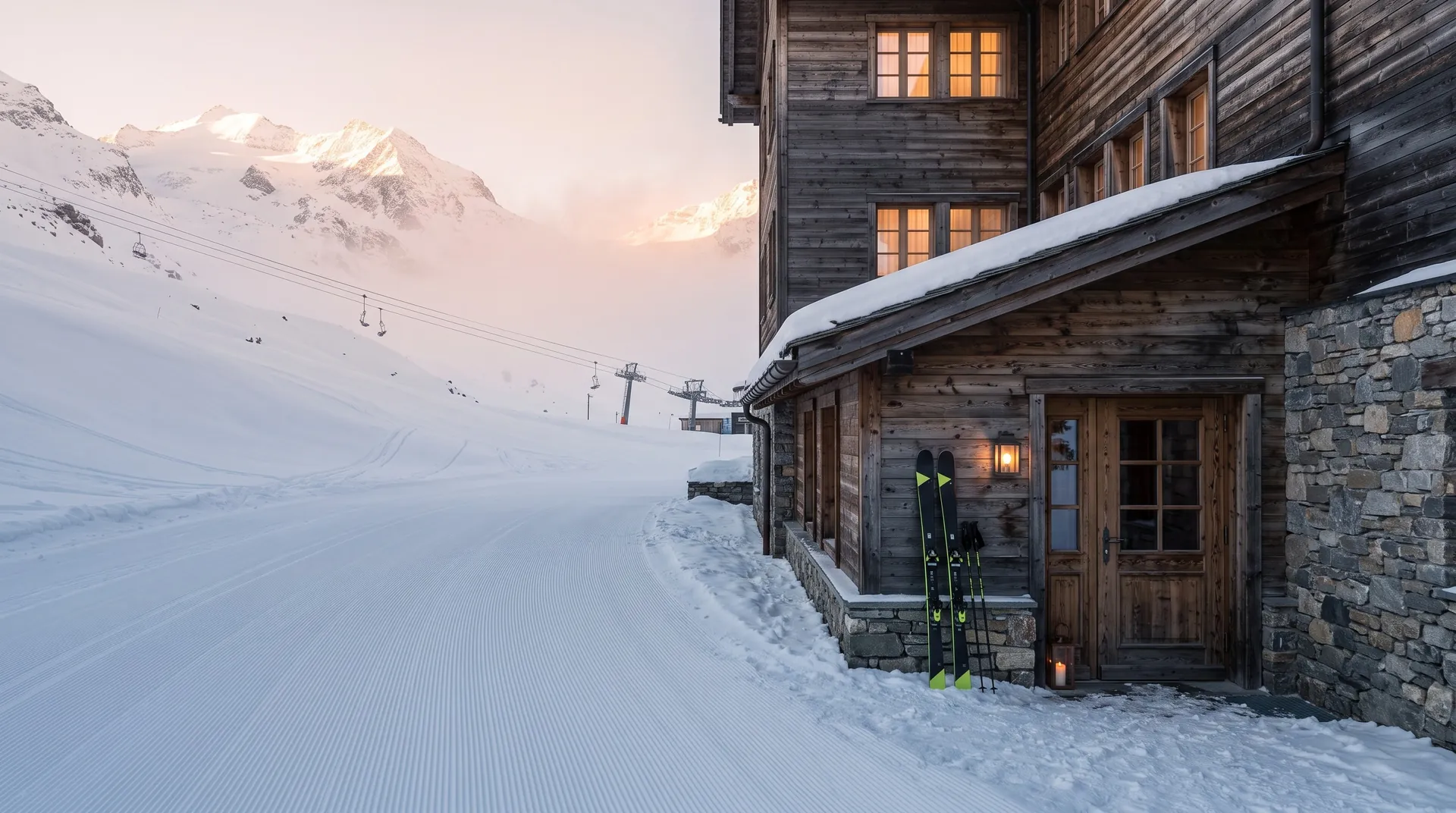
- Door to piste, both ways. You put your skis on outside the ski room, ski to a lift and ski back to the door at the end of the day. This is true ski-in ski-out, and it is rarer than the marketing suggests.
- Ski-out only. You can ski away in the morning, but the property sits above the run home or beside a piste that leads elsewhere, so getting back needs a lift, a walk or a shuttle.
- Ski-in only. The run home ends at the door, but in the morning you walk or take a lift to reach the first piste.
- Close to the piste. A short walk, a flight of steps or a road separates the door from the snow. A minute on a cleared path is easy; ten minutes in boots carrying a child’s skis is not.
- Access by private transport. A shuttle, a small funicular or a ski concierge takes you to the lift. This can be excellent, but it is a service, not ski-in ski-out.
Ask the property which of these describes it, in plain words.
The run home
The return run is where most claims fall apart. Look at its grade first. If the only way back to the door is a red or a black run, a beginner or a tired child cannot ski home, and the family ends the day on a gondola. Some return runs are long, narrow paths across the mountainside, gentle in gradient but icy and crowded at the end of the afternoon.
Check what kind of run it is. In Switzerland, for example, some descents are marked ski routes rather than pistes: secured against avalanches but not groomed. On the piste map they appear in a different style, explained in the legend.
Timing matters too. To ski home you often need to catch a particular lift before it closes, and some runs shut at a set time so that grooming machines can start work. Ask which lift you need to reach the run home and when the last one runs.
Ski rooms, boot warmers and valets
A good ski room turns direct access into real comfort. Look for heated boot racks, so you start each morning in warm, dry boots, a bench to sit on while you buckle up, racks for skis and poles and, ideally, a door that opens straight onto the snow. A ski room down a corridor, across a lobby or on the far side of the street undoes much of the advantage.
Ask whether there is a rental shop or ski technician on site for fitting and tuning, and whether staff carry skis to the piste and collect them at the end of the day. Some hotels without direct access offer a heated locker at the lift base, which can be nearly as convenient: you walk over in light shoes and change at the lift.
Late in the season
Snow disappears from the bottom of a resort first. In March and April, the lower slopes and the runs home are the most exposed: lowest altitude, most traffic and often facing the afternoon sun. A property that is ski-in ski-out in February can be a ski bus stop at Easter.
Before a late season stay, ask what happened to the run home last March and April, whether it has snowmaking and how long it usually stays open. On warm spring afternoons the run home turns to heavy slush, so ski the higher slopes in the morning and come back early or by lift.
The same applies at the start of the season. In December, the run home may not open until enough snow has fallen or been made, and a lower property can depend on a gondola for the first weeks.
Children and direct access
With children, direct access is a gift: lunch and naps at home, no carrying skis through the village, a quick return for a forgotten glove. It also needs some care. A door that opens onto a busy piste means fast skiers passing close by, and small children should not be able to run out onto the snow unseen.
Check where ski school groups meet and where the nursery slope is. A property on a red run far above the beginners’ area is ski-in ski-out for the adults only. Look at the nearby lifts too: drag lifts can be hard for small children, while a gentle chairlift or a moving carpet is far easier.
After the lifts close, the pistes become a work zone. Grooming machines run into the evening, some on steep slopes held by steel cables that are almost invisible in the dark. Keep children, sledges and evening walks off the pistes after closing time.
How to verify it on a piste map
A piste map and a satellite view can confirm or overturn a ski-in ski-out claim in ten minutes.
- Find the property on the piste map and on a satellite view. Ask for its exact position if it is not marked.
- Trace the run that passes the door. Note its colour and the lift it leads to, and check that you can reach that lift without pushing uphill.
- Trace the way back. Which lift do you need at the end of the day, and what colour is every run between it and the door?
- Look for roads, car parks, streams or steps between the door and the piste.
- Note the altitude of the property and compare it with the lowest point of the ski area.
Then ask the property for a photograph taken from the ski room door in winter, and put two direct questions: can I clip in at the door and ski to a lift, and can I ski back to the door at the end of the day? Ask too until which month both answers stay yes. In deep snow regions such as Niseko, ask also how paths and doorways are kept clear after a heavy night’s snowfall.
Questions readers ask
What does ski-in ski-out actually mean?
In its true form, you put your skis on at the door, ski to a lift and ski back to the door at the end of the day. In practice the term is also used for properties that need a short walk, a road crossing or a lift to reach the snow. Ask for the exact route in both directions.
Is ski-in ski-out worth paying extra for?
For families with young children, early starters and anyone who dislikes carrying skis, it often is. It matters less if the hotel has a ski concierge or heated lockers at the lift base. Check that the run home suits the weakest skier in your group.
Does ski-in ski-out still work in March and April?
Often, but not always. The runs at the bottom of a resort lose their snow first and turn slushy on warm afternoons. Ask whether the run home has snowmaking and how long it usually stays open in spring.
Independent editorial guidance. Our guides name no resorts, and resortris takes no payment for coverage. Seasons and conditions are general and can vary from year to year.
Try it nowBest Time to Go: The Resort CalendarChoose a month and see where the season is at its best, with typical air and sea temperatures for twenty four resort destinations.