






The Maldives Atolls Explained: How to Choose Where to Stay
Twenty-six atolls and one main gateway. How distance, reefs, monsoon currents and local islands shape where to stay in the Maldives.
On a booking page the Maldives look like a single destination; on a map they look like scattered confetti. In fact the country is a long chain of twenty-six natural atolls reaching across the equator, each a ring of reefs and islands around a lagoon. Where you stay along that chain decides how you arrive, what swims past the house reef and, to a degree, the weather. Here is how to read it.
Atoll geography in brief
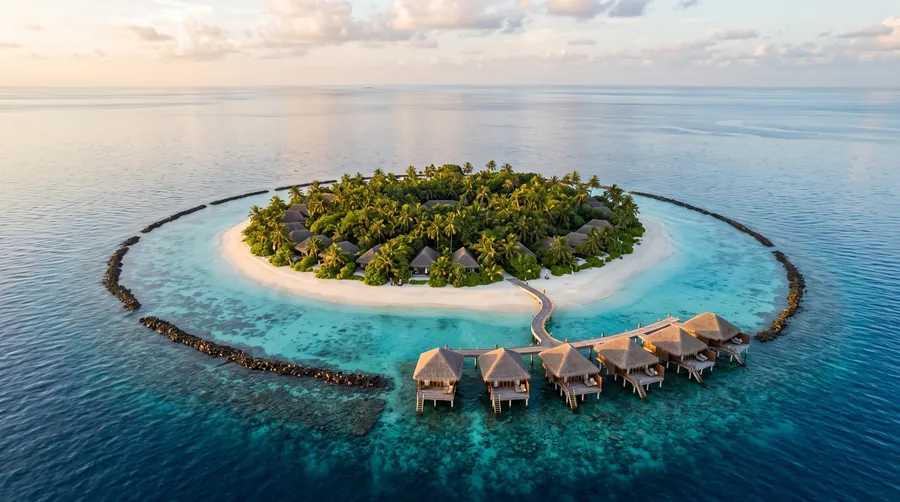
An atoll is a ring of coral reefs and islands enclosing a lagoon, broken by channels where the ocean flows in and out. The Maldives have twenty-six natural atolls, grouped into twenty administrative ones, with around twelve hundred islands in all. Almost all are low, flat coral islands, and many are small enough to walk around before breakfast.
The names can confuse. Many atolls have a traditional name and an administrative one: North and South Malé Atoll together form Kaafu, Ari Atoll is divided into Alif Alif and Alif Dhaal, and the great southern atoll of Huvadhu is split into Gaafu Alif and Gaafu Dhaal. Resort descriptions use either, so check both when you compare.
A few local words help with reef descriptions: a kandu is a channel through the reef, a thila is a submerged reef top, and a giri is a coral formation that reaches close to the surface.
Distance from Malé decides the transfer
Nearly all international flights land at the airport beside Malé, and your distance from it shapes the first and last day of the stay.
- North and South Malé Atolls: speedboat, usually from a quarter of an hour to around an hour. Late arrivals are rarely a problem, and the short transfer suits short stays. Islands closest to the airport may see aircraft or the lights of the capital.
- Ari, Baa, Lhaviyani, Raa, Noonu, Vaavu and Dhaalu: mostly reached by seaplane, so your arrival depends on daylight. Some resorts in these atolls can also be reached by domestic flight and boat.
- The far north and the deep south: Haa Alif, Haa Dhaal, Laamu, Huvadhu and Addu are reached by a domestic flight of around an hour or more, then a boat or car. The extra leg is rewarded with fewer resorts and quieter water.
Further is not better in itself. A remote atoll gives you space; a near one gives you an extra half day on the beach at each end. On a stay of five nights or fewer, that half day matters.
House reefs: choose the island, not the atoll
Every atoll has islands with excellent house reefs and islands without one, so the choice is made island by island. The pattern to look for is a small island with a narrow lagoon on at least one side, where the reef edge comes within a short swim of the beach. Large islands with wide lagoons are often better for swimming and children, but their reef may be a boat ride away.
Islands on the outer rim of an atoll, near the channels, tend to see more large fish and stronger currents. Islands inside the lagoon are usually calmer, with gentler snorkelling. Ask where the entry points are and how far they are from your villa, then look at a satellite view: the dark blue line of the drop-off tells you more than any brochure.
Marine life seasons, stated carefully
The monsoons shape life underwater as much as above it. During the north-east monsoon, roughly December to April, currents generally run from east to west across the atolls: clearer ocean water tends to arrive on the eastern side, while plankton-rich water flows out on the western side. During the south-west monsoon, roughly May to November, the pattern reverses. Manta rays follow the plankton, so they are more often seen on the western side of atolls in the first part of the year and on the eastern side in the second.
Some places have their own reputations. Baa Atoll is a UNESCO Biosphere Reserve, and its Hanifaru Bay draws gatherings of feeding mantas, mostly between about May and November; visits are managed, snorkelling only and limited in numbers. South Ari Atoll is known for whale sharks, which can be seen through much of the year. Fuvahmulah, a single-island atoll in the deep south, is known among divers for its sharks.
Nothing in the sea is guaranteed. Treat these as tendencies, ask the resort's dive centre about recent sightings and leave a spare day or two for the boat trip that matters to you.
Weather from north to south
The Maldives have two main seasons. The north-east monsoon, from about December to April, brings the driest, sunniest weather and calmer seas. The south-west monsoon, from about May to October, brings more rain, stronger winds and livelier seas, though rain often comes in heavy showers with bright spells between them.
The atolls do not share the weather equally. The southern atolls, closest to the equator, have a less distinct dry season and somewhat more rain overall, with showers possible in any month. The differences are moderate: choose your atoll for its reefs and transfers first, and use the weather as a tie-breaker.
Local islands and resort islands
Resort islands are given over entirely to tourism: one island, one resort. Maldivians live on the inhabited islands, fewer than two hundred of them, from the dense capital of Malé to quiet fishing communities. Many now have guesthouses and small hotels, and many resorts offer excursions to a nearby village.
The two worlds keep different rules. Local islands are Muslim communities: alcohol is not sold there, modest dress is expected away from designated tourist beaches and Friday prayers shape the rhythm of the day. A visit is the best way to see Maldivian life, its boatbuilders, mosques and markets, and it gives the resort some context. Cover shoulders and knees, and ask before photographing people.
If a resort is described as close to a local island, check the distance and the direction. A village across the lagoon brings the call to prayer, harbour sounds and evening lights; some guests enjoy that, others prefer nothing but sea on the horizon.
Combining two atolls
A split stay is easy in principle and needs careful timing in practice. Moves between resorts in different atolls usually route back through the seaplane base or the airport, so a change takes most of a morning or afternoon, and seaplane times are often confirmed only the day before. Within one atoll, a direct boat transfer is sometimes possible.
Good combinations pair contrasts. A remote atoll with a strong house reef for the main part of the stay, then a night or two in North or South Malé Atoll within a short speedboat ride of the airport, makes the departure day relaxed. Others pair a week in Baa during the manta months with a quieter lagoon island elsewhere, or take a domestic flight south for the reefs of Huvadhu or Addu. Allow at least three nights in each place; anything shorter is spent mostly in transit.
Questions readers ask
Which Maldives atoll is best for snorkelling?
There is no single best atoll, because house reefs vary from island to island. Look for a small island with a narrow lagoon, where the reef edge is a short swim from the beach. Baa and Ari are well known for mantas and whale sharks, but good house reefs exist in many atolls.
Which part of the Maldives has the best weather?
The whole country is at its driest from about December to April. The southern atolls, closer to the equator, have a less distinct dry season and showers in any month. The differences are moderate, so choose reefs and transfers first.
Can I stay on a local island instead of a resort in the Maldives?
Yes, many inhabited islands now have guesthouses and small hotels. They give you a view of Maldivian life but follow local rules, including no alcohol and modest dress away from designated beaches. Some travellers combine a few nights on a local island with a resort stay.
Independent editorial guidance. Our guides name no resorts, and resortris takes no payment for coverage. Seasons and conditions are general and can vary from year to year.
Try it nowResort Budget Planner: The Whole Stay at a GlanceBuild an indicative budget for a resort stay: villa category, nights, flights, island transfer, board and extras, with the cost per night and per person.