





Desert Resorts · The guide
Desert Resorts: Silence, Dunes and the Best Months to Go
Sand sea, stony plateau, canyon or mountain: how to choose a desert, when to go, and what the big temperature swing means for your stay.
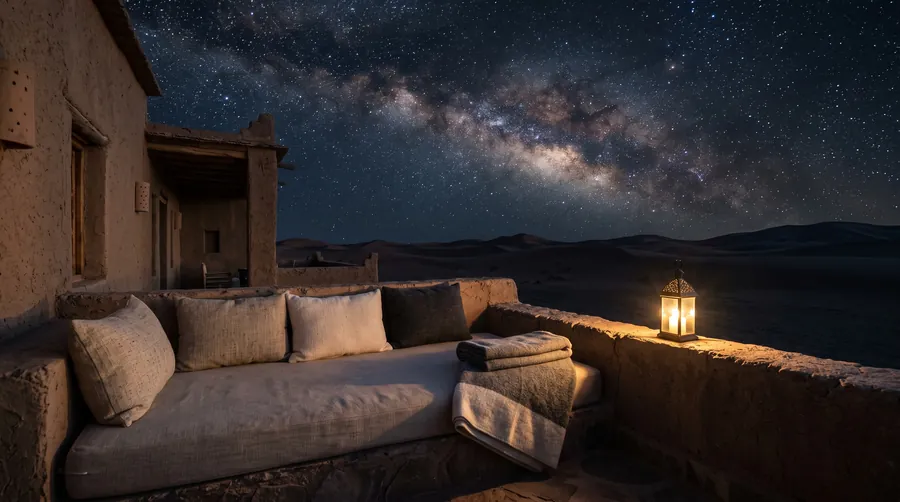
A desert stay is sold on silence, and the silence is real. What varies is everything around it: whether the view is a sea of dunes or a stony plateau, whether January nights are mild or close to freezing, whether the pool is warm enough to use. Choosing well starts with the landscape, then the month, then the details that brochures rarely mention, from the water supply to the sound of quad bikes on the next ridge.
Four kinds of desert, four kinds of stay
A desert is defined by low rainfall, not by sand, and the landscape you choose shapes every day of the stay. Four broad types cover most desert resorts.
- Sand sea. The classic dune desert, known as an erg: the edge of the Rub' al Khali around Liwa in Abu Dhabi, the Wahiba Sands in Oman, Erg Chebbi in eastern Morocco, the Namib. Expect sunrise walks along ridges, soft sand underfoot and a sense of scale that photographs never quite carry.
- Rocky plateau. Stony, rolling ground with little or no loose sand. The Agafay near Marrakech is the best known example: ochre hills, a long view to the High Atlas, and a drive from the city short enough for dinner in the medina. It is a desert landscape, but not a dune landscape.
- Canyon desert. Sandstone cliffs, arches and dry riverbeds, as in Wadi Rum in Jordan, AlUla in Saudi Arabia or the canyon country of Utah. Light on rock walls at dusk is the main event, and hiking matters more than dune driving.
- Mountain desert. Arid ranges such as the Hajar Mountains of Oman or the high Atacama in Chile. Altitude brings cooler air, steep gorges and terraced villages. At the highest lodges the thinner air can take a day or two to get used to, and anyone with a heart condition should ask a doctor first.
Many trips combine two types. In Oman the dunes, the mountains and the sea lie within a few hours' drive of each other, which makes a split stay easy to arrange.
The best months, and why the calendar is narrow
In the Arabian deserts the comfortable season runs roughly from November to March. Daytime highs in the mid twenties make walking and riding pleasant, and nights in the dunes turn cool, sometimes dropping into single figures. From May to September the inland desert regularly passes 40 °C. Many tented camps close, and the resorts that stay open run on air conditioning and very early mornings.
October and April are the shoulder months, with highs typically in the low to mid thirties: fine for a pool day, tiring for a walk at noon. They are quieter and often better value, but late October can still feel like summer in the Gulf.
Morocco follows a different calendar. Around Marrakech and the Agafay, March to May and October to November are the sweet spots. Winter days are often sunny and mild, but clear nights can come close to freezing, and the High Atlas may be white with snow, a fine backdrop if your room is heated. July and August are hot, often well above 35 °C.
Southern hemisphere deserts turn the year around. In the Namib and the Kalahari, the dry winter from about May to September brings clear skies, comfortable days and cold nights, while the summer months are hot.
Living with the temperature swing
Dry air holds little heat. Once the sun sets the ground cools quickly, and a terrace that felt hot at five o'clock can feel chilly by eight. In winter, a swing of well over ten degrees between mid-afternoon and the small hours is normal in the dunes.
This shapes the day. Activities cluster at the edges: a dune walk or camel ride at sunrise, a long lunch and a rest in the middle, a drive to a ridge for sunset. From December to February, dinner outdoors needs a fire pit, a heater or a proper jacket. Ask whether your tent or villa has heating as well as cooling, and whether extra blankets are standard.
In summer the swing works against you in a different way. Nights stay warm, the sand holds its heat for hours after dark, and the sun is fierce from mid-morning. Bare feet on dune sand at midday can burn, so keep shoes on until the evening.
What there is to do
The better desert resorts keep the programme simple and timed to the light. Expect a menu along these lines.
- On foot: sunrise walks on the dunes, guided hikes in wadis and canyons, and short morning walks to read the night's tracks of foxes, beetles and lizards in the sand.
- With animals: camel treks of an hour or two at dawn or sunset, and horse riding where the ground is firm, as in the Agafay.
- By vehicle: 4x4 dune drives, sandboarding and fat bikes on harder sand. Quad bikes and dune buggies are loud; if silence is the reason you came, ask where and when they run.
- From the air: hot air balloon flights at dawn in several desert regions, weather permitting, with a very early pick-up.
- Culture and wildlife: falconry demonstrations, visits to Bedouin or Amazigh (Berber) communities arranged with care, and in conservation reserves, drives to look for oryx and gazelle.
- After dark: stargazing with a guide and telescope, and dinners in the dunes.
Two or three nights suit most people in a dune camp. A week works where the resort also offers mountains, a spa or culture within reach, as in the Agafay with Marrakech nearby, or in Oman with the Hajar Mountains and the coast.
Pools, water and sustainability
A pool in the desert is a luxury in the literal sense. In the Gulf the water usually comes from desalination, in Morocco and inland Oman from groundwater, and at remote camps it may be trucked in. None of it is free in any ecological sense, and how a resort handles water says a lot about the place.
Useful questions: is greywater treated and reused for planting, is the landscaping native and dry rather than lawn, are there solar panels or does a generator run through the night, and is drinking water filtered on site rather than delivered in plastic bottles. A resort that answers clearly, without vague green language, usually runs well in other respects too.
On the practical side, pool temperature varies more than you might expect. In January an unheated pool in the dunes or the Agafay can be bracing, so ask whether it is heated if swimming matters to you. In summer the reverse applies, and some resorts cool their pools. Private plunge pools are common with villas; tented camps more often share one pool between all guests.
The ground itself is fragile. Tyre tracks across gravel plains and the thin living crust on desert soil can take years to recover, which is why the better operators keep vehicles on set routes.
What to pack
- Light, loose, long-sleeved clothing for the day, and a fleece or down jacket for winter nights.
- A large cotton scarf to wrap over nose and mouth in wind, and a wide-brimmed hat with a cord so it stays on.
- Closed shoes or sandals with a heel strap for sand, and light boots for canyon and mountain walks.
- Good sunglasses, high factor sunscreen, lip balm and a rich moisturiser, because dry air works fast on skin.
- Glasses as well as contact lenses, since fine sand and dry air can make lenses uncomfortable.
- A head torch with a red light setting, for paths at night and for stargazing.
- Modest clothing, with shoulders and knees covered, for villages, markets and towns in Oman, Morocco and the Gulf.
Keep cameras and phones in a sealed bag when the wind picks up, and change lenses indoors. Fine sand is hard to remove from a sensor, and harder still from a zoom mechanism.
Choosing the resort itself
Look at the location on a satellite map before you book. Some desert resorts sit at the edge of a city with a highway in view; others lie at the end of a long sand track. Both can be right, but you should know which you are getting. Check the drive time from the airport, whether the last stretch needs a 4x4, and whether arrivals after dark are possible.
Ask how many rooms or tents there are and how far apart they stand. In a landscape this open, sound carries, and a large resort with a busy activity programme feels very different from a camp of a dozen tents.
Check what happens on a windy day. Sand-laden wind can blow for a day or more in any desert, and a short stay can lose an afternoon to haze. An indoor lounge, a library or a spa makes that easy to sit out.
Finally, check the dates of Ramadan, which move about eleven days earlier each year. Resorts carry on looking after guests as usual, but towns are quieter by day and some excursions and visits change their hours.
Questions readers ask
What is the best month to visit a desert resort?
For Dubai, Abu Dhabi and Oman, November to March is the comfortable season, with warm days and cool nights. Around Marrakech and the Agafay, March to May and October to November are usually best. In the deserts of southern Africa the dry winter from about May to September is the classic time.
How cold does the desert get at night?
In the winter months the dunes cool sharply after sunset, and nights in single figures are not unusual in the Arabian deserts. Inland Morocco can come close to freezing on clear winter nights. Pack a warm layer and ask whether your room is heated.
Are there sand dunes in the Agafay desert?
Not in the sense of a sand sea. The Agafay is a stony desert of rolling hills and plateaus with views to the High Atlas. For tall dunes in Morocco you need to travel to the edge of the Sahara in the east of the country, such as Erg Chebbi, which is a long drive or a domestic flight and a transfer from Marrakech.
Independent editorial guidance. Our guides name no resorts, and resortris takes no payment for coverage. Seasons and conditions are general and can vary from year to year.
Try it nowBest Time to Go: The Resort CalendarChoose a month and see where the season is at its best, with typical air and sea temperatures for twenty four resort destinations.